
Gout 🦶
On-call guide to an acute gout flare: rule out septic arthritis, then colchicine, NSAID, or prednisolone. Based on Miller and McCarthy, Medical Independent 2025.
📖 Presentation
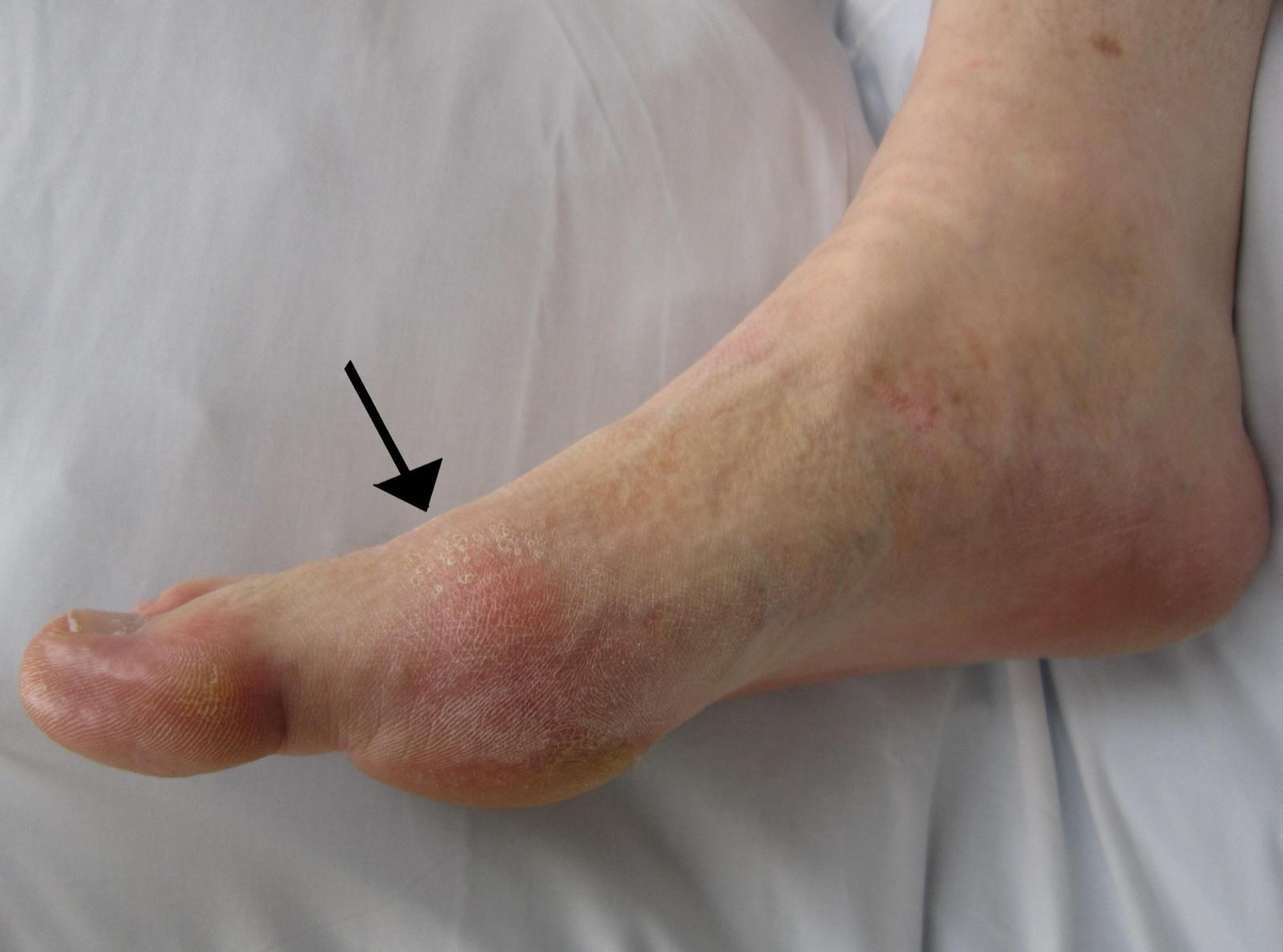
- Suspect gout when there is rapid onset of severe pain, redness, and swelling in one or both first metatarsophalangeal (MTP) joints, midfoot, ankle, knee, hand, wrist, or elbow. Tophi support the diagnosis.
- Typical flare (podagra): exquisite pain, heat, redness, and swelling. Untreated, it usually settles in 7–10 days.
- Crystals deposit most often at the first MTP, midfoot, and Achilles, but any joint can be involved.
- Redness may be slight, and is harder to see on darker skin. Compare with the other foot and go by pain, heat, and swelling.
- Always weigh septic arthritis and other inflammatory arthritis. Known gout does not exclude infection.
🚨 Rule out septic arthritis first
- This is the key step before treating a flare.
- Suspect septic arthritis if the flare is atypical for a patient already known to have gout, there has been a penetrating injury to the joint, or the patient is immunocompromised.
- If septic arthritis is at least as likely as gout, send the patient for emergency assessment with arthrocentesis and synovial fluid analysis. Do not treat as gout and leave.
- Do not inject corticosteroid into a joint that might be infected.
🔍 Assessment
- Onset, joint(s), previous flares or tophi, and whether this looks like their usual attack.
- Precipitants: diuretics, dehydration, alcohol, high-purine intake, acute gastroenteritis, recent illness.
- Medicines that increase gout risk: loop, thiazide, and thiazide-like diuretics; ACE inhibitors; non-losartan ARBs; ciclosporin; tacrolimus; ritonavir. Do not stop heart-failure diuretics overnight without a senior.
- Medicines associated with lower gout risk: urate-lowering therapy, losartan, calcium-channel blockers, SGLT2 inhibitors.
- Comorbidities that change flare treatment: CKD, heart failure, peptic ulcer, anticoagulation, diabetes, liver disease. Gout is commoner as eGFR falls.
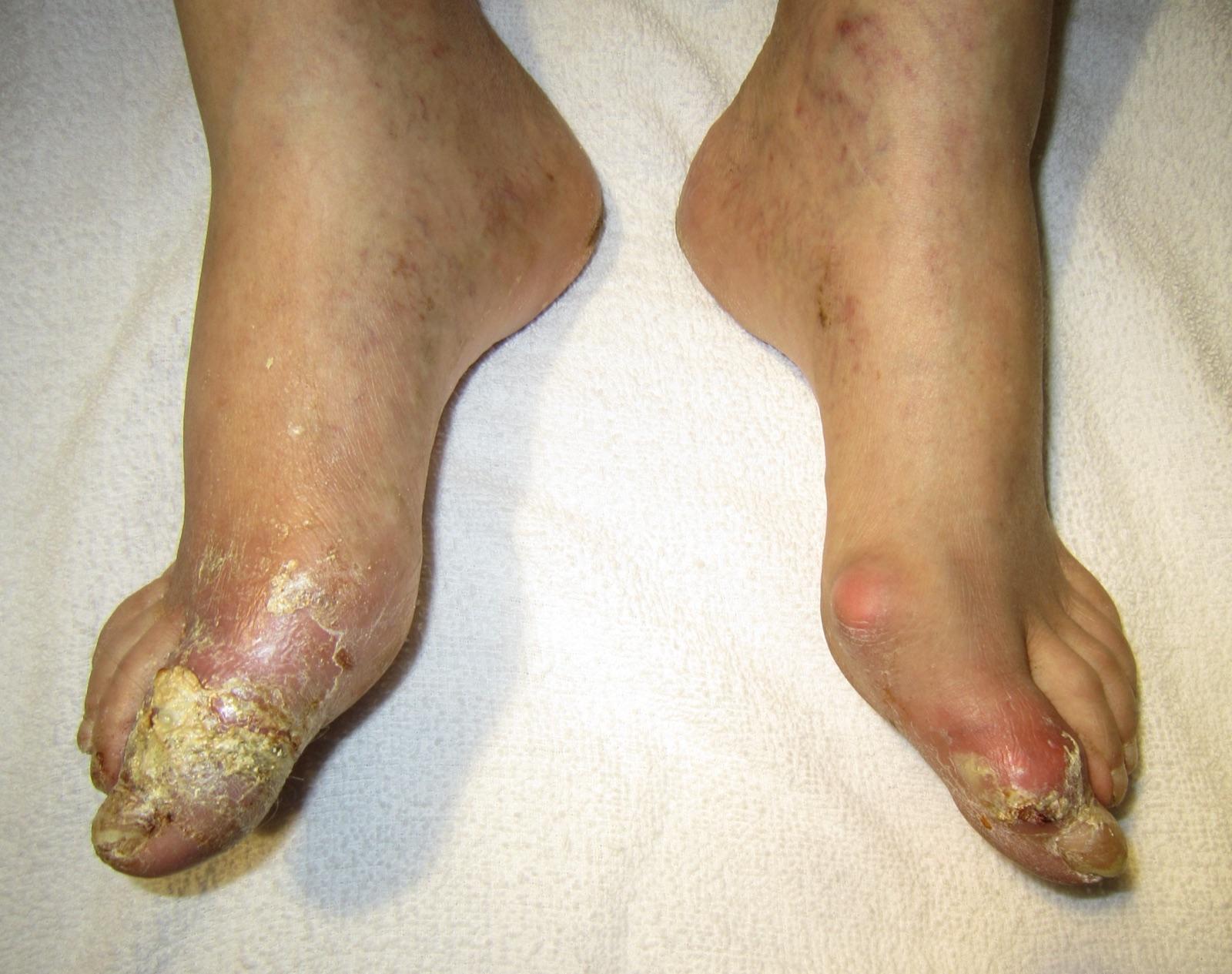
- Examine the joint and surrounding skin. Look for tophi (ears, elbows, fingers, Achilles). The photo below is severe chronic tophaceous gout, not a typical first flare.
- Vitals and a sepsis screen if systemically unwell.
🧪 Investigations
- Polarised-light microscopy of synovial fluid is the ideal diagnosis, but most on-call settings will not have it overnight. A clinical diagnosis is acceptable.
- Clinical suspicion is supported by serum urate >360 micromol/L (>6 mg/dL).
- Urate can be <360 micromol/L during a flare (increased renal excretion and crystal sequestration into the joint). A normal urate tonight does not rule gout out. Recheck between flares.
- Ultrasound can further support the diagnosis if it remains uncertain. That is a day-team test, not a typical overnight request.
- If treating as possible septic arthritis: aspirate for crystals, Gram stain, and culture, plus blood cultures if unwell.
- Bloods that change prescribing: FBC, U&E / eGFR, CRP, LFTs.
💊 Treating a flare
- Once septic arthritis is not the working diagnosis, treat with colchicine, an NSAID, or prednisolone. Each is equally effective. Choose from patient factors, not a fixed order.
- Use one agent first. Combine two if the response to monotherapy is inadequate.
- Intra-articular methylprednisolone acetate is an alternative and avoids some systemic steroid risk (senior / rheumatology). Do not inject if infection remains possible.
- Anakinra is not an on-call start. Rheumatology may use an IL-1 antagonist if flares do not respond to NSAID, colchicine, and glucocorticoid.
- Tablet doses below are from BNF / Irish licences (colchicine 0.5 mg tablets). The review does not specify oral doses. Confirm local formulary and renal dosing.
⏳ Urate-lowering therapy during a flare
- Continue existing allopurinol or febuxostat through the flare. Stopping it can worsen the attack.
- If they are not already on ULT, it may be started while the flare is still being treated. Do not start it yourself overnight unless a senior agrees the flare is covered and a starting dose is clear.
- Guidelines often wait 2–4 weeks after a flare. Concurrent start is acceptable when the flare is being treated.
- ULT should be offered from the first presentation if there are comorbidities, urate >480 micromol/L, or onset under 40 years. Leave titration for the day team.
- Treat-to-target: <360 micromol/L, or <300 micromol/L if tophi, frequent attacks, or chronic arthropathy. Lifelong once started.
- Allopurinol or febuxostat can both be first-line. Consider HLA-B*5801 risk (East Asian ancestry, severe renal impairment) before allopurinol. Febuxostat may be preferred in that group. Genetic screening should be considered before allopurinol in those patients.
- Starting ULT can itself trigger flares. Co-prescribe colchicine or a low-dose NSAID for the first 3–6 months. That cover is a day-team job if you are not the one starting ULT.
📋 After the flare
- Leave a clear plan: how confident the diagnosis is, whether aspiration is still needed, which flare drug was started, and whether ULT was continued or a senior agreed a start.
- Diet changes help some patients but are not a substitute for ULT.
- Consider rheumatology if the diagnosis is uncertain, the patient has had an organ transplant, or CKD is stage 3–5. Also if two ULT agents have failed, or flares do not respond to NSAID, colchicine, and glucocorticoid.
- Complicated patients with hepatic or renal impairment: ask rheumatology rather than pushing colchicine.
Related NICE guidance
NICENICE NG219 — Gout: diagnosis and management (Jun 2022)
Full guidance on nice.org.uk. BetterCall is not endorsed by NICE.
Note Template
Ready-to-use clinical note structure
🕒 21 / 09 / 2026 — 15:02

ATRP re: gout flare / hot joint
Patient: [age] [sex]
Admission Dx: [reason for admission]
PMHx: [gout, CKD, heart failure, peptic ulcer, diabetes, transplant]

🧾 Hx:
• Onset: [overnight / hours] — joint(s) [1st MTP / midfoot / ankle / knee / other]
• Previous flares / tophi: [yes/no]
• Precipitants: [diuretic / dehydration / alcohol / surgery / none]
• Current ULT: [none / allopurinol / febuxostat — continued Y/N]
• Allergies:

🩺 Exam:
• Vitals: HR __ BP __ Temp __
• Joint: hot, red, swollen, exquisitely tender [Y/N]
• Range of movement / weight-bearing: [findings]
• Tophi: [yes/no — site]
• Surrounding cellulitis / portal of entry: [yes/no]
• Prosthetic joint: [yes/no]

🔬 Investigations:
• Urate: __ micromol/L (repeat ≥2 weeks after flare if <360 and gout still likely)
• FBC, U&E/eGFR, CRP, LFTs
• Aspiration: [not indicated / requested / sent for crystals + Gram + culture]
• Blood cultures: [if unwell]

📋 Impression:
[Known gout flare / suspected gout / cannot exclude septic arthritis]

📌 Plan:
• Septic arthritis: [not suspected / at least as likely as gout — emergency arthrocentesis]
• Flare treatment (Miller and McCarthy 2025): [colchicine / NSAID / prednisolone / combination / IA methylpred if infection excluded]
• ULT: [continued usual dose / senior agreed start while flare treated / not started]
• Day team: recheck urate between flares, comorbidities, treat-to-target ULT
• Rheumatology if: uncertain diagnosis, transplant, CKD 3–5, two ULT failed, flares not responding

👤 [Your Name], [Role]
IMC: _______
Educational reference only. Medical disclaimer